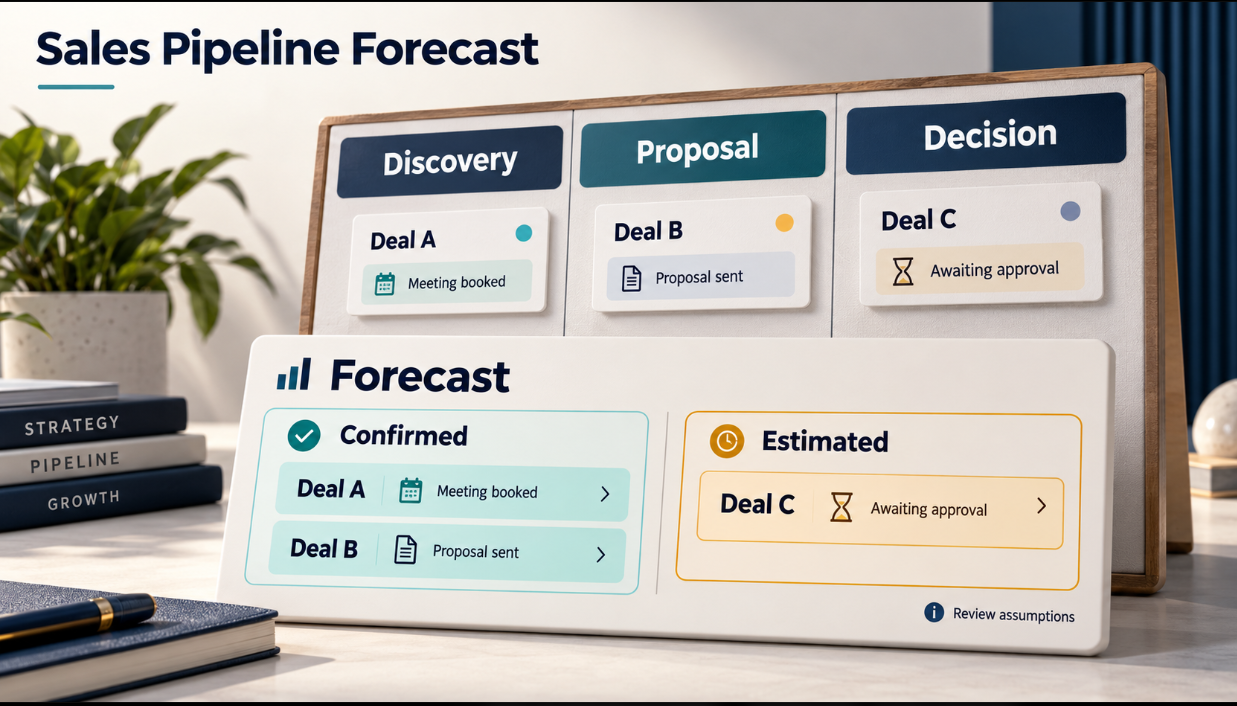
Pipeline forecasts help teams discuss workload, timing, and potential revenue. They can mislead when stages mean different things to different people or when an optimistic estimate is presented as a confirmed outcome.
Clear stage definitions and explicit assumptions make the forecast easier to interpret and improve over time.
A practical perspective
Define stages using observable evidence
Describe what must have happened before an opportunity enters each stage, such as a completed discovery call, a confirmed need, or a proposal requested by the customer.
Avoid stages that rely only on a representative’s general feeling. Evidence gives teams a more consistent basis for discussion without eliminating professional judgment.
A practical perspective
Record timing, value, and uncertainty
Keep expected value and timing tied to what is known about the opportunity. Record missing information and external dependencies, such as procurement or an upcoming decision meeting.
If probability weighting is used, explain how it is derived and review it against historical outcomes. A percentage is a planning aid, not a guarantee.
A practical perspective
Use the forecast to ask better questions
Review changes in stage, timing, and owner. Ask what evidence supports the change and what action would reduce uncertainty. Consider the age of opportunities and whether follow-up is still welcome.
Compare past forecasts with actual outcomes to improve definitions and assumptions. Keep individual customer data limited to the team members who need it.
Put the insight to work
Practical next steps
- 01
Write stage entry rules
Define observable criteria for each stage and apply them consistently.
- 02
Capture key assumptions
Record expected timing, value, dependencies, and evidence behind each estimate.
- 03
Review changes regularly
Discuss significant movement and identify actions that can reduce uncertainty.
- 04
Compare estimates with outcomes
Use historical accuracy to refine forecast methods without overstating certainty.
Key takeaways
Keep the next decision clear.
- Use observable evidence to define pipeline stages.
- Separate estimates from confirmed commitments.
- Review forecast accuracy and assumptions as part of the sales process.